
The Institutional Data Buyer Is Changing | B2B Sales for Data Providers

Updated: 5 days ago

For years, selling market data into a bank or asset manager rewarded a particular skill: finding the one person who could say yes.
A market data manager with budget authority, or a front-office sponsor who wanted your feed badly enough to push it through. Win that relationship and the rest of the process was navigable. Procurement negotiated terms, legal papered the contract, and the deal closed on the strength of a champion.
That path still exists. However, it is getting narrower, and the reason is worth understanding if you sell data, analytics, or infrastructure into financial institutions.
The market data function inside these firms is being redefined. What had previously been treated as a procurement and compliance unit, measured on discounts extracted and audits survived, is being rebuilt as a cross-functional operation that sits closer to the front office and is expected to enable revenue rather than only control cost.
The recent FISD white paper, Accelerating Peak Performance in Your Market Data Teams, describes the shift directly: the goal is to move from a reactive, order-taking posture to an advisory model organized around three pillars:
Transparency
Cost optimization
Innovation
Cost discipline still matters, but it now shares the agenda with a mandate to help the business use data more effectively across research, investment, risk, and operational workflows.
For a seller, the important consequence is structural: as the function's mandate widens, so does the set of people who have to agree before you get paid.
What is changing about the institutional data buyer?
Buying decisions increasingly extend beyond a single market data or front-office champion to include stakeholders across engineering, procurement, finance, legal, risk, and compliance, each evaluating the purchase against a different definition of value.
A champion in one seat can still open the door. Closing increasingly requires agreement across the stakeholder map.
The buying committee expanded while you were selling to one seat
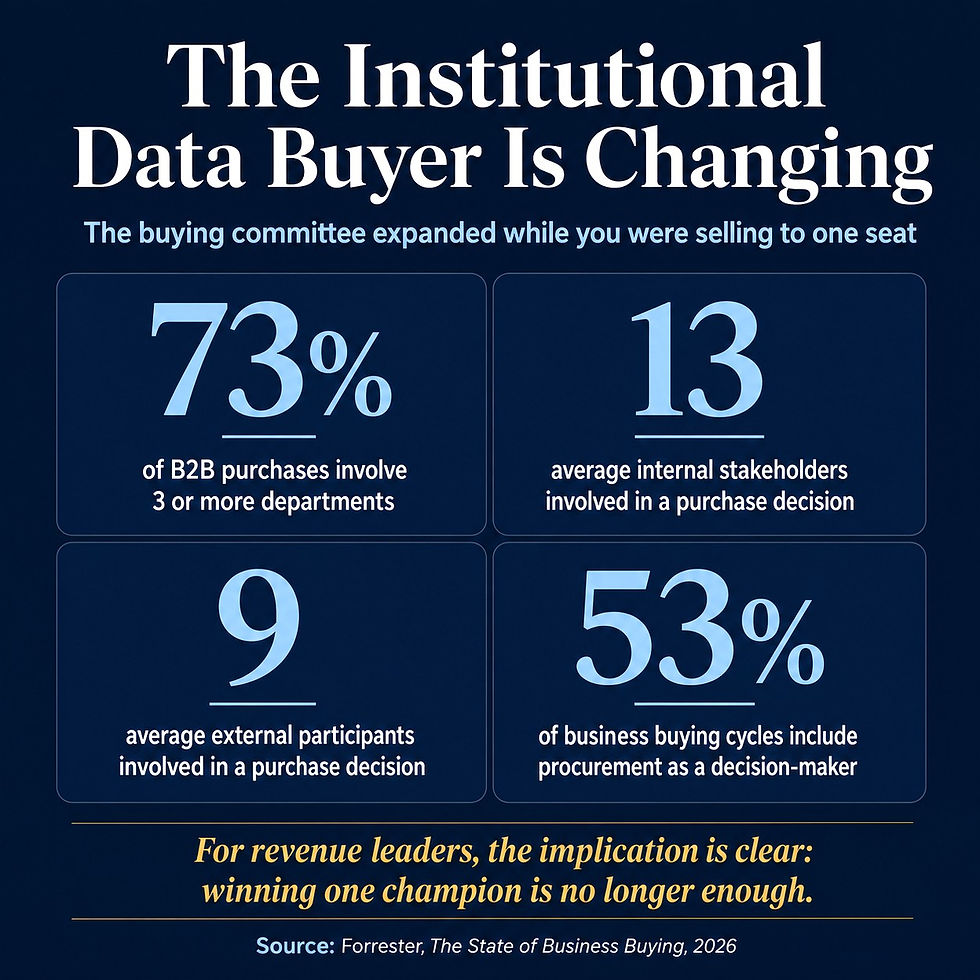
For a revenue leader selling complex technology or data into a financial institution, that should sound familiar.
The FISD white paper maps the modern market data operation across five capabilities:
Demand governance
Vendor and licensing management
Inventory and consumption tracking
Financial engineering for chargebacks
Data engineering and distribution
What that implies, and what it looks like in practice, is that each capability has the potential to introduce another stakeholder, requirement, or point of friction.
Take demand governance. Someone may challenge whether the business actually needs your feed before it enters the catalog.
Licensing management means someone may scrutinize your usage rights, redistribution terms, and increasingly your AI and model-training clauses.
Financial engineering means someone has to attribute your cost to a consuming desk and defend it in a quarterly review.
Data engineering has to ingest, entitle, and distribute your data through cloud pipelines without creating downstream breakage.
Top-tier execution depends on dedicated market data engineering and IT infrastructure teams supporting the commercial function.
The buying system now regularly spans front office, market data, engineering, procurement, finance, legal, risk, and compliance.
Different stakeholders define value differently
Stakeholder | The question they are trying to answer |
Front Office | Does this improve the investment, trading, or research process? |
Market Data | Do we already have something similar, and can we govern it? |
Engineering | Can we ingest and support it? |
Finance | Is the spend justified? |
Legal & Compliance | What exactly are we allowed to do with the data? |
That means the seller is no longer building one value proposition for one buyer and the challenge is not simply reaching more stakeholders. It is building a business case that survives several different definitions of value.
That requires a different sales capability.
The operating model is evolving
It would be easy to read a single white paper as aspiration and move on. The broader evidence makes the direction more convincing.
FISD also maintains a library of Best Practice Recommendations covering audit conduct, derived data, non-display usage, subscriber agreements, service levels, and billing and invoicing. Several of these disciplines have been in place for years. The underlying issues are not new.
What has changed is that more mature market data teams are connecting them to business value, engineering, governance, and innovation rather than running them as isolated back-office chores.
One useful example is FISD's vendor scorecard, a shared framework that evaluates suppliers across more than 70 attributes grouped into six categories:
Administration
Commercial models and contracts
Product quality
Product support
Relationship management
Risk management
An institutional data buyer can assess your firm systematically across dimensions your salesperson may never see in a meeting.
A strong relationship with a sponsor and a strong institutional assessment of your firm are different things.
And the second is becoming harder to win on charm, however one caveat matters. Best practices are voluntary, adoption varies, and its white papers and other discussion documents do not necessarily represent consensus across the industry.
So this should not be read as a universal operating model.
The important signal is the direction of travel. More mature market data organizations are broadening the function well beyond procurement and compliance.
The sales motion has to evolve too
If the buyer is becoming a system, the generic persona most GTM motions still run on, "Head of Market Data," is no longer enough to plan around.
The practical question for a revenue leader is whether the sales process can build and hold agreement across the full buying architecture, or whether it depends on a single relationship that another function can stall.
That is a different capability to build than product differentiation.
It requires a sales process that can uncover how each stakeholder defines value, engage the right functions early, and build a business case that holds up across commercial, technical, governance, and operational review.
A strong dataset may earn attention.
A strong sales motion has to give each function a reason to say yes.
Sellers who build that motion will be better positioned to convert sophisticated accounts.
Sellers who keep optimizing the single-champion play will increasingly run into deals where enthusiasm from the user is not enough to get the institution across the line.
The buyer is getting more disciplined and your response needs to match that discipline which requires a set of choices most data companies have not yet made deliberately.
Sources
FISD: Accelerating Peak Performance in Your Market Data Teams and FISD Best Practice Recommendations. FISD Best Practice Recommendations
Forrester: The State Of Business Buying, 2026. Forrester reports that a typical buying decision includes 13 internal stakeholders and nine external influencers, with buying groups increasing for more complex or strategic purchases. Forrester: The State Of Business Buying, 2026
Moore Consulting LLC advises fintech, data, and infrastructure companies selling into financial services on GTM strategy, positioning, and sales execution.
Moore Insights examines how revenue teams translate strategy into execution as complexity scales.


Comments